India Just Got a Seat at the Big Table
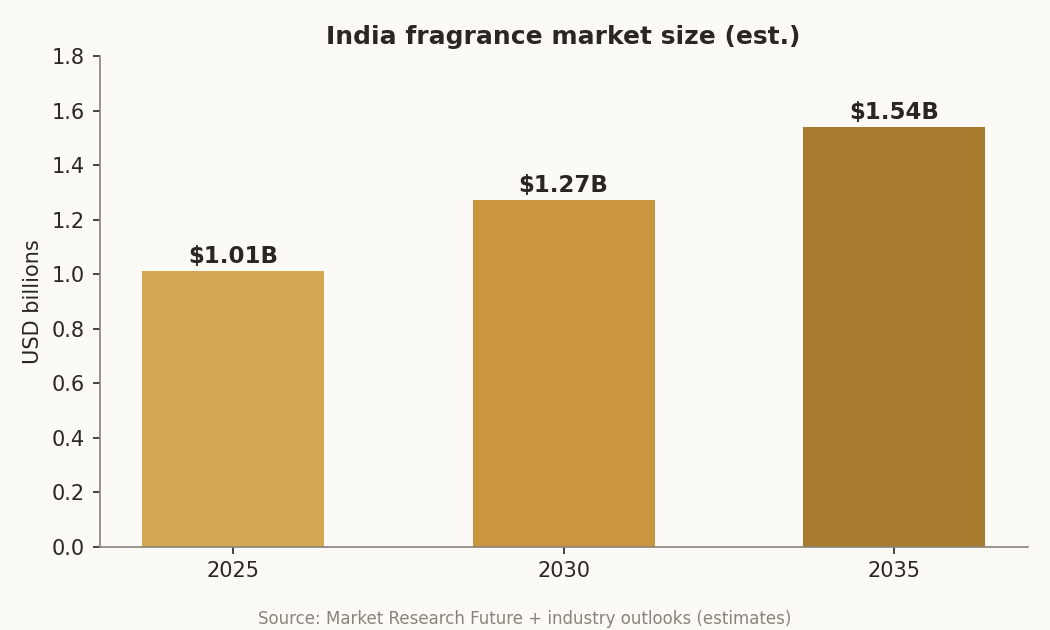
Here are the numbers, and they are worth sitting down for. Independent estimates put India's fragrance market at $1.0 to 1.25 billion today, heading toward $1.5 to 2 billion by the mid-2030s. That is roughly 4 to 5% growth a year. Modest next to the global pie, until you remember the West grows at half that rate.
| Data point | Number | Source |
|---|---|---|
| Global fragrance market | $69.7B, ~5.5% CAGR | Future Market Insights |
| India fragrance market | $1.0-1.25B today | Market Research Future + industry outlooks |
| India fragrance growth | 4-5% CAGR to ~$2B by mid-2030s | Industry outlooks |
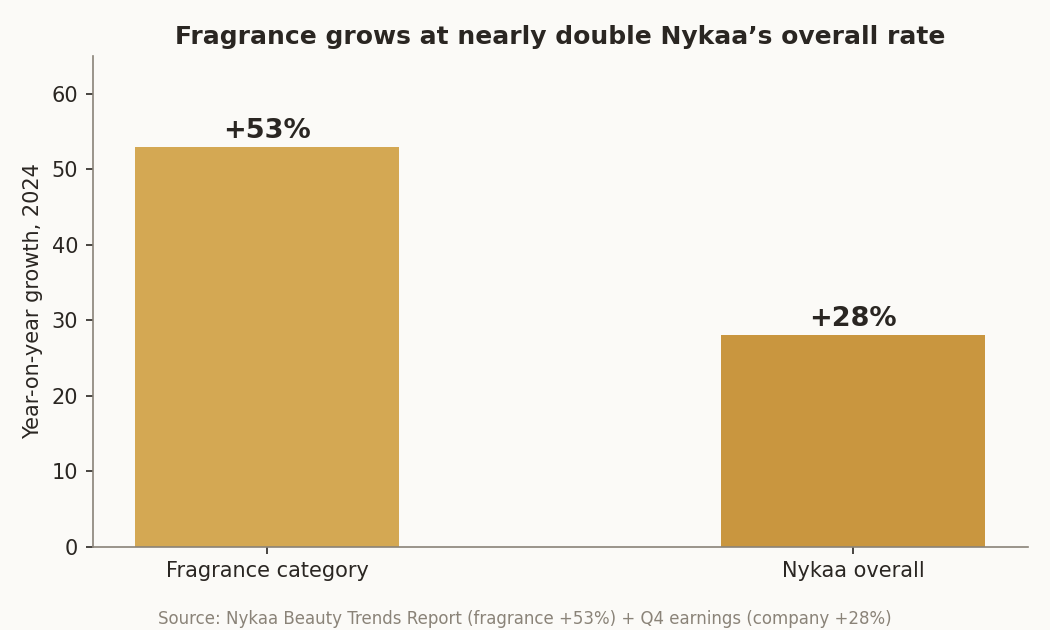
| Nykaa fragrance vs total | Fragrance +53%, overall +28% (2024) | Nykaa reports |
| India beauty market by 2028 | ~$34B | Nykaa-Redseer report |
| IFRA 51st amendment | Phased compliance, Oct 2025 through 2026 | IFRA / UL |
The retailer data is even louder. Fragrance was Nykaa's fastest-growing category: up 53% in 2024, nearly double the company's overall 28% growth in the same period. Nykaa's total revenue later accelerated to 54% year-on-year in Q1 2026, a pace the fragrance category set first. Every brand that reads those numbers reaches the same conclusion: if you are not in India, you are growing where growth has stopped.
Three Billion-Dollar Companies Walk Into a Fragrance Market
Three moves this month show where the money is pointing. Agilex Fragrances, part of the Firmenich group, bought Fragrance West. Symrise agreed to acquire German house Floral Concept. L'Oréal invested in Chinese home-fragrance brand To Summer. On their own, these look like routine deals. Together, they are the supply chain getting into position. The world's two biggest ingredient suppliers are consolidating, and the biggest beauty group on earth is buying Asian fragrance assets. They are not betting on Paris. They are betting on Asia's mass markets, and India is the largest of them. What does that mean for your wallet? Honestly, nothing this month. What it means in two years: ingredient costs will drift up, and the value houses that live on thin margins will feel it first. Watch, do not panic.
What Buyers Are Actually Doing (Spoiler: They Are Checking Prices)
The demand side is not theory. It is visible in the community data. A thread that pulled 347 upvotes shared Dubai wholesale prices that shocked buyers: Hawas Kobra Shop ↗ at $14.98, Hawas Chrome Shop ↗ at $21, against Indian street prices roughly double that. The reaction was the most Indian thing possible: a nationwide hunt for cheaper sources. Decant culture is booming. The 30-days-30-reviews format became a thing. And influencers are now being reviewed themselves: a 415-upvote thread called out paid hype for Mykonos and Velixir. Buyers this engaged, this price-sensitive and this willing to research stop being a discount market. They become a strategic market.
The Fake Perfume Problem Is Getting Scary (No, That Deal Is Not Real)
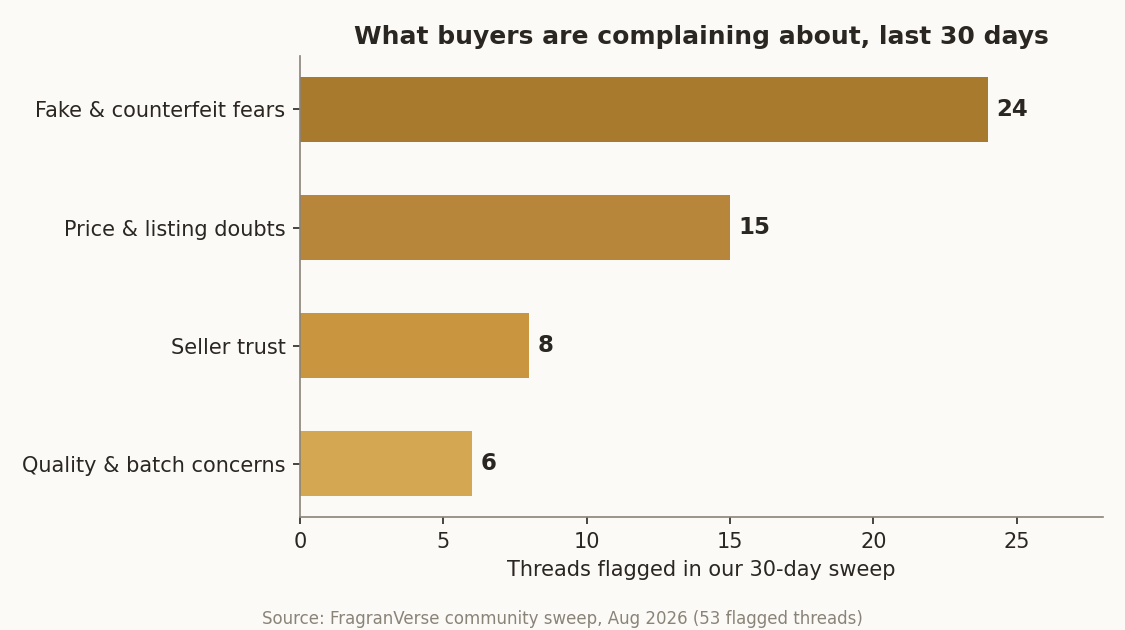
Here is the pain point that changes the business case. In the last 30 days across six fragrance communities, fake and trust issues showed up in 53 threads. One warned that counterfeit quality is getting scary, with factories producing near-identical fakes. Another turned into a lesson on fake Amazon listings. Dozens of is-this-original posts follow the same arc. This is not paranoia. The FBI has documented counterfeit fragrances containing DEHP, a probable human carcinogen. Academic work on counterfeit cosmetics in India documents the same health risks. Every fake bottle is a lost sale for a legitimate brand, and that is exactly the opening the official players are walking through. If a price looks too good, it is not a deal. It is a science experiment you did not sign up for.
Here is what the community actually said in the last 30 days. A thread on counterfeit quality pulled 93 upvotes: factories producing near-identical fakes, with buyers warning that even careful shoppers get caught. An Amazon reviews never disappoint thread (275 upvotes) turned into a lesson on fake listings. A discount-hunting post, Crazy Discount on JPG Le Male Intense, drew 96 comments of is it original. And a thread about being scammed by a department store pulled 222 upvotes. Batch and maceration worries are the quieter twin of the fake problem. A 205-upvote thread asked for the correct maceration process, and the brand actually replied with steps. A review thread (170 upvotes) revealed that Khadlaj announces it macerates its bottles before bottling, while the bottle under review was literally made this month. And a 276-upvote thread on a 2010 Creed Aventus batch asked the question every collector knows: is an old batch rare, and does it matter? These threads are the consumer voice behind the business story. Buyers are scared of fakes, confused about batches, and desperate for someone official to trust. That desperation is the exact demand the direct-to-consumer brands are built to answer.
Middle Eastern Houses Are Cutting Out the Middleman (and the Fakes)
Here is what is actually shifting: ME houses are going direct, the way designer brands did decades ago. Ajmal runs an official India storefront with Indian pricing. Lattafa sells direct in the US with a 100 percent authentic, direct from Lattafa promise, pushed its US launch at CosmoProf Miami in early August, and works through authorized dealers in India. The community saw this coming. A 494-upvote thread noted that ME houses are now raising prices transparently, and the top comment called it the end of the golden era of bargain fragrances. That is not a bad thing. Direct channels cut out the retailer margin that counterfeiters live in. They give brands control over the authenticity story, and they give you a verified place to spend. The fakes thrive in the gap between brand and buyer, and the brands are closing the gap.
The IFRA Elephant in the Room: Compliance Is Coming for Indian Brands
Here is the part most buyers have not connected yet. IFF, one of the three biggest fragrance ingredient suppliers in the world, is building a new scent creative center in Mumbai. That is not a hobby. It is a bet that Indian formulation happens in India. And with it comes IFRA compliance, the rulebook that decides what can go into a perfume. The IFRA 51st amendment started phasing in from October 2025, with the next wave landing through 2026. It tightens limits on several fragrance ingredients. Brands that sell in Europe or the US must comply. Indian and ME value houses increasingly want those export markets, which means their formulas are changing to stay legal. Sound familiar? That is the same mechanism behind every the new batch is weaker thread you have ever read. Compliance is real, it is here, and it is quietly rewriting formulas. The honest take: compliance is good for safety and terrible for hype. A bottle that smells slightly different next year is not a scam, it is a rulebook doing its job. The brands that communicate this honestly will earn trust. The ones that pretend nothing changed will feed the batch-worry machine.
What This Means for You (Yes, You, the One with 47 Decants)
Four practical takeaways. One: official channels are now the safest buy. Two: prices will firm up, not collapse, as brands control distribution. Three: new launches arrive direct first, so official sites are the new release radar. Four: the community sellers who verify authenticity will survive this transition, and the ones who just move boxes will not.
Verdict
- Buy if: you want to know exactly what is in the bottle. Official channels are the safe option now, not the expensive one.
- Skip if: you are waiting for the golden era of 1,500-rupee monsters to return. It is ending by design.
- Best for: Indian buyers who want to shop the transition without getting caught in the fake gap.
Compare any bottle against your shelf on FragranVerse, with notes, similarity scores and community ratings.
Check a bottle on FragranVerse →