Fragrance Note
Ylang-Ylang
Used in 449+ fragrances on FragranVerse
What it smells like
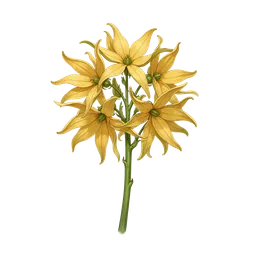
Ylang-ylang is the flower of Cananga odorata, a fast-growing tropical tree in the Annonaceae family, native to the Philippines and Southeast Asia. The name derives from the Tagalog ilang-ilang, meaning 'wild' or 'of the wilderness'. Not 'flower of flowers,' a persistent mistranslation that no primary Tagalog source supports. Commercial production centers on the Comoros archipelago (Anjouan accounts for roughly 25. 30% of the world's estimated 60. 80 annual tonnes), followed by Madagascar's Nosy Bé, the Philippines, and Réunion. What distinguishes ylang-ylang from every other floral oil is the fractional distillation. The flowers are steam-distilled over 15. 20 hours, and the process is interrupted at intervals to siphon off successive grades: Extra, First, Second, and Third. Extra grade. The fraction used in fine fragrance. Is lightest and richest in volatile compounds: benzyl acetate (15. 30%), linalool (7. 24%), p-cresyl methyl ether (7. 13%), methyl benzoate (4. 9%), and geranyl acetate (2. 14%).
How it's used in perfumery
Ylang-ylang functions as a heart-to-base floral with notable volume-building capacity. In classic amber and floral-amber compositions it provides the dense, creamy floral body. Its primary technical virtue is the p-cresyl methyl ether content, which gives it a unique animalic-phenolic bridge to musks and leather accords. No other floral raw material delivers this quality at comparable intensity. It blends with jasmine absolute (amplifying the indolic axis), sandalwood (extending the creamy warmth), and bergamot or neroli (counterbalancing the sweetness with citrus transparency).
Fun fact
Ylang-ylang is the only commercially distilled essential oil that is routinely fractioned during a single distillation run, with grades collected as Extra, First, Second, Third, and Complete.