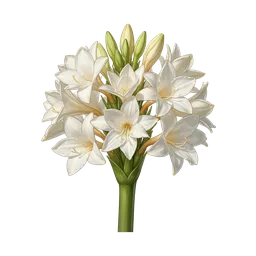
Fragrance Note
Tuberose
Used in 425+ fragrances on FragranVerse
What it smells like
Tuberose (Agave amica, syn. Polianthes tuberosa) belongs to the Asparagaceae family, subfamily Agavoideae. A relative of agave, not of roses or lilies. The plant is native to Mexico, where the Nahuatl-speaking peoples called it omixochitl. Bone flower, from omitl (bone) and xochitl (flower). For the waxy whiteness of its petals. Tuberose was introduced to Basse-Provence in 1632 by Father Théophile Minuti, a friar who traveled in the Levant collecting plants. India now dominates global production. GC-MS analysis identifies trans-methyl isoeugenol as the dominant odorant at roughly 15. 20%, with indole supplying the characteristic animalic-fecal undertone at 1. 2%.
How it's used in perfumery
Tuberose is a statement material. It dominates any composition it enters. As a heart note, it provides narcotic floral mass and creamy volume that lighter florals like neroli or freesia cannot deliver alone. Its primary function is as a volume builder: it expands the perceived projection and sillage of a composition without adding sharpness. Essential to the white-flower accord. Jasmine + tuberose + ylang. And to many amber-floral and chypre-floral architectures.
Fun fact
Under Louis XIV, the royal gardeners at the Grand Trianon procured around ten thousand tuberose bulbs for the king's pleasure gardens. A quantity recorded in Versailles supply ledgers. The royal demand helped fix tuberose as one of Grasse's signature flowers through the eighteenth and nineteenth centuries.
Perfumes with Tuberose(80 of 425)
Middle East
(20)
Designer
(40)
Niche
(17)